If you’re a sole trader, understanding cash basis accounting can make managing your business records and completing your Self Assessment considerably easier.
Cash basis accounting is now the standard way of recording business income and expenses for eligible sole traders and partnerships without corporate partners. Instead of recording income when you issue an invoice and expenses when you receive a bill, you normally record them when the money is actually received or paid.
For many self-employed people, this creates a simpler connection between bookkeeping, cash flow and taxable profit. However, cash basis is not necessarily the best choice for every business, and you can choose traditional accounting if that gives a more useful picture of your finances.
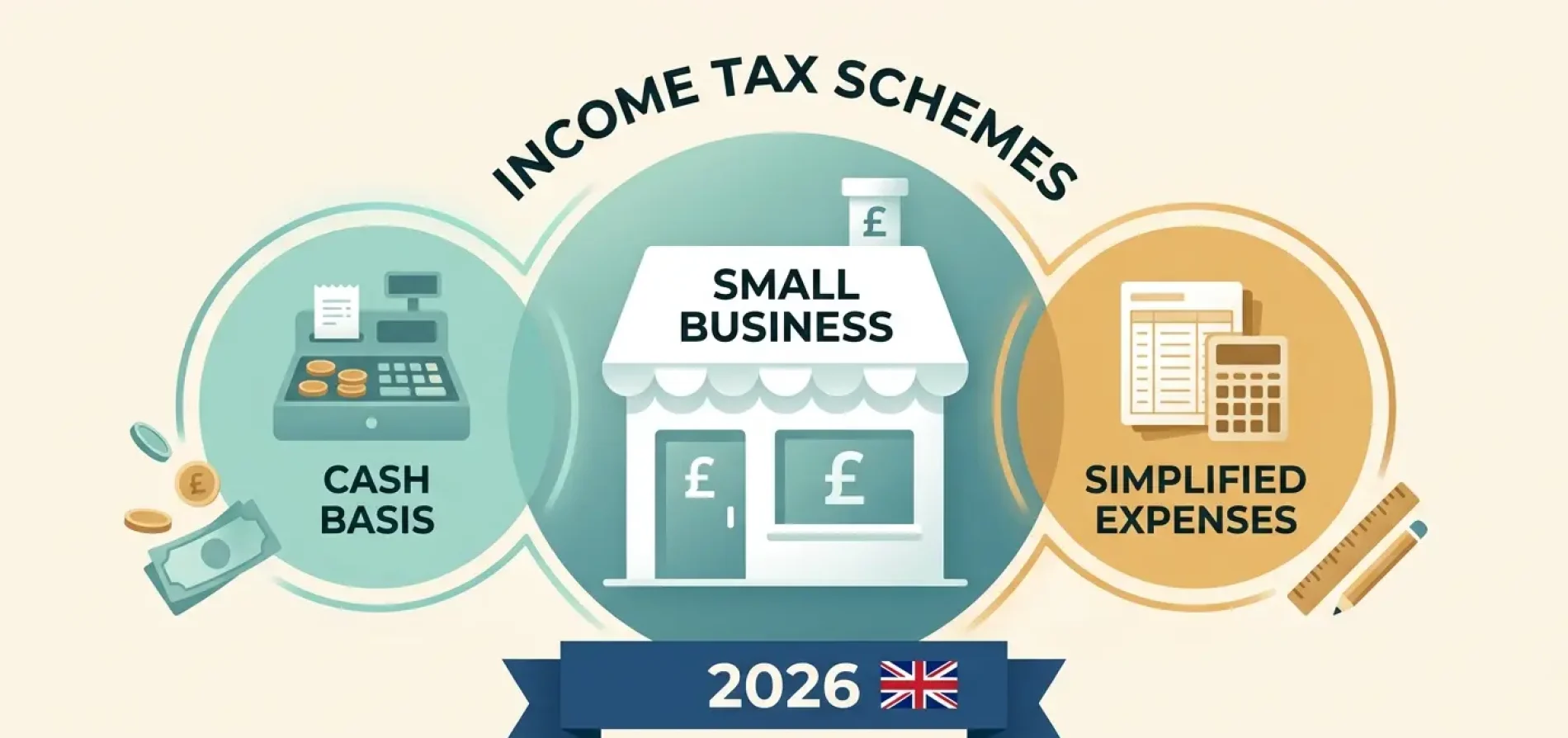
There is also a separate set of rules known as simplified expenses, which allows eligible sole traders to use HMRC flat rates for certain vehicle costs, working from home and living at business premises.
This guide explains how cash basis accounting works in 2026/27, who can use it, when traditional accounting may be more appropriate, how simplified expenses work and how the rules interact with Making Tax Digital for Income Tax.
Important: This guide provides general information about UK tax and accounting rules. Your tax treatment will depend on your individual circumstances. Professional advice should be obtained where necessary.
What is cash basis accounting?
Cash basis accounting is a way of calculating the taxable profit of an eligible self-employed business based largely on when money is actually received and paid.
In simple terms:
- income is generally recorded when your customer pays you; and
- expenses are generally recorded when you pay them.
This differs from traditional accounting, sometimes called accruals accounting, where income and expenses are generally recognised according to when they are invoiced or incurred, even if payment takes place at a later date.
HMRC describes cash basis accounting as the standard method for sole traders and partnerships without corporate partners.
A simple cash basis example
Suppose you are a sole trader and issue a customer invoice for £4,000 on 25 March 2027.
Your customer does not pay the invoice until 20 April 2027.
If you use cash basis accounting, you would normally record that £4,000 when the payment is actually received in April.
That means the income would generally fall into the later tax year rather than being recognised simply because the invoice had already been issued.
The same broad principle applies to allowable expenses: you generally record them when you actually make the payment.
This is one of the main reasons cash basis can be easier for smaller businesses to understand.
Is cash basis accounting now compulsory for sole traders?
Cash basis became the default accounting method for eligible businesses from 6 April 2024.
However, “default” does not mean you are forced to use it in every situation.
An eligible sole trader can choose to use traditional accounting instead.
That choice may be appropriate where traditional accounts provide more useful financial information for the business, its owners, lenders or other users of the accounts.
If you’re uncertain which approach is suitable, our small business accountants can help you review your bookkeeping, accounts and tax position.
Who can use cash basis accounting?
Cash basis accounting is generally available to:
- sole traders; and
- partnerships where there are no corporate partners.
It is not available under these Income Tax rules to limited companies.
Certain specialist businesses and circumstances can also be excluded from cash basis, so businesses with unusual activities should check the detailed rules before relying on it.
If you’re deciding whether to operate as a sole trader or through a company, read our guide to sole trader vs limited company in the UK.
If you already operate through a company, our limited company accountants page explains the accounting and tax support available to incorporated businesses.
Can a limited company use cash basis accounting?
No. The Income Tax cash basis rules covered in this guide are not available to limited companies.
Limited companies have separate accounting and Corporation Tax requirements.
This distinction is important because searches for “cash basis accounting” sometimes mix together rules applying to sole traders, partnerships, landlords and limited companies.
This article specifically focuses on cash basis accounting for self-employed trading businesses.
Is there still a turnover limit for cash basis accounting?
The old general cash basis turnover limits no longer apply to eligible trading businesses in the way they did previously.
Before the changes from 6 April 2024, the cash basis generally had a £150,000 entry threshold and a £300,000 exit threshold.
From the 2024/25 tax year, cash basis became the default method for eligible businesses and those general turnover restrictions were removed.
This means sole traders should not continue applying the old £150,000 limit when deciding whether cash basis can be used for current trading income.
Eligibility and whether the method is genuinely suitable for your business are now more important considerations.
Cash basis vs traditional accounting: what’s the difference?
Understanding the difference between cash basis and traditional accounting is one of the most important parts of choosing an accounting method.
| Cash basis accounting | Traditional accounting |
|---|---|
| Income generally recorded when received | Income generally recorded when earned or invoiced |
| Expenses generally recorded when paid | Expenses generally recorded when incurred |
| Closely follows cash entering and leaving the business | Includes amounts owed to and by the business |
| Often simpler for smaller businesses | Can provide a fuller financial picture |
| Default for eligible sole traders | Can be chosen instead |
| Fewer year-end accounting adjustments in many cases | Often involves accruals, prepayments and other adjustments |
HMRC specifically notes that a business may prefer traditional accounting where it is more complex, holds significant levels of stock or needs accounts prepared in that way to support an application for finance.
When can cash basis work particularly well?
Cash basis may suit a straightforward sole trader where most customers pay promptly and the owner mainly wants an uncomplicated way of recording income and expenses for tax purposes.
It can also make it easier to see the relationship between:
money received → money spent → taxable business profit.
That simplicity can be particularly useful where the business does not have complicated stock, financing or year-end accounting requirements.
When might traditional accounting be better?
Traditional accounting may deserve consideration where your business:
- carries substantial stock;
- regularly has large unpaid customer invoices;
- owes significant amounts to suppliers;
- is applying for business finance;
- needs more detailed financial reporting;
- wants a clearer picture of debtors and creditors; or
- has more complicated accounting arrangements.
A simpler accounting method is not automatically the best accounting method.
The right choice depends on how your business operates and what information you need from your accounts.
What income do you record under cash basis?
Under cash basis accounting, business income is generally included when you actually receive the money.
This can include payments received by:
- bank transfer;
- debit or credit card;
- cash;
- cheque; and
- other methods of payment.
The important principle is normally receipt of the money, rather than simply the date you sent an invoice.
This can mean that you do not pay Income Tax on ordinary trading income that a customer has not yet paid you. HMRC’s cash basis guidance confirms this principle.
You should still maintain proper records of invoices, payments and business transactions.
If keeping records is becoming difficult as your business grows, see our bookkeeping services.
What expenses can you claim under cash basis?
Using cash basis does not mean every payment leaving your bank account becomes tax deductible.
The normal rules concerning business expenses still matter.
Depending on the nature of the expenditure, deductible costs can include items such as:
- business premises costs;
- office and administrative costs;
- certain business travel costs;
- professional fees;
- relevant training costs;
- stock and goods purchased for resale;
- machinery and equipment; and
- certain finance costs.
HMRC’s cash basis rules allow many day-to-day business costs to be deducted when they are paid, but special rules can apply to particular assets and expenses. Cars, for example, have different rules from many other items of equipment.
For a broader explanation of deductions, see our guide to allowable business expenses for the self-employed.
What are simplified expenses?
Simplified expenses are different from cash basis accounting.
This distinction is important.
Cash basis is an accounting method used to determine when business income and expenses are recognised.
Simplified expenses are optional flat-rate calculations that eligible self-employed people can use for certain specific business costs.
HMRC currently allows simplified expenses for:
- certain vehicle costs;
- working from home; and
- living at business premises.
Simplified expenses can be used by sole traders and partnerships that do not have companies as partners. Limited companies cannot use these simplified expense rules.
You do not have to use the flat rates.
If calculating your actual allowable costs gives you a better result, you may choose the actual-cost method instead, subject to the relevant tax rules.
Can you use cash basis and simplified expenses together?
Yes.
Cash basis and simplified expenses perform different jobs, so an eligible business can use both.
For example, a sole trader could:
- use cash basis to determine when business income and expenses are recognised; and
- use HMRC’s simplified mileage rate to calculate the allowable vehicle expense.
HMRC confirms that the simplified vehicle method is optional regardless of whether the business also uses cash basis.
So it is incorrect to think that you must choose between:
cash basis OR simplified expenses.
The real decisions are:
Cash basis or traditional accounting?
and, separately:
Simplified expenses or actual costs for the relevant expense?
Simplified mileage rates for 2026/27
There has been an important change to mileage rates for the 2026/27 tax year.
From 6 April 2026, the simplified mileage rate for the first 10,000 business miles in cars and goods vehicles increased from 45p to 55p per mile.
The current rates are:
| Vehicle | 2026/27 rate |
|---|---|
| Cars and goods vehicles – first 10,000 business miles | 55p per mile |
| Cars and goods vehicles – business miles above 10,000 | 25p per mile |
| Motorcycles | 24p per mile |
HMRC confirms that the 55p rate applies retrospectively from 6 April 2026 for the 2026/27 tax year.
Example: 12,000 business miles
Suppose you use your car for 12,000 qualifying business miles during 2026/27.
Your simplified mileage calculation would be:
First 10,000 miles:
10,000 × £0.55 = £5,500
Remaining 2,000 miles:
2,000 × £0.25 = £500
Total simplified vehicle expense:
£6,000
This is the amount calculated under the mileage method before considering whether all the journeys satisfy the relevant business-travel rules.
For a deeper explanation of the mileage rules, visit our guide to business mileage allowance rates for 2026/27.
Can you switch between mileage and actual vehicle costs?
Care is needed when choosing how to claim vehicle expenses.
HMRC states that you cannot use simplified vehicle expenses for a vehicle where you have already claimed capital allowances or included the vehicle as an expense when calculating business profits.
Once you start using the flat-rate method for a particular vehicle, you normally continue using that method for as long as that vehicle is used in the business.
This is one area where choosing the method before making a claim can be important.
Simplified expenses for working from home
Many sole traders run some or all of their business from home.
Instead of calculating the precise business proportion of household costs, eligible self-employed people can use HMRC’s simplified working-from-home rates.
You must work from home for at least 25 hours during the month to use the flat-rate method.
The rates are:
| Business hours worked from home each month | Flat rate |
|---|---|
| 25 to 50 hours | £10 per month |
| 51 to 100 hours | £18 per month |
| 101 hours or more | £26 per month |
The flat rate does not include telephone and internet costs. The appropriate business proportion of those costs can potentially be calculated separately.
Example: working from home
Suppose you work from home for 60 hours every month throughout the tax year.
You would fall within the 51–100 hours band.
The calculation would therefore be:
12 months × £18 = £216
That would give a simplified homeworking expense of £216 for the year.
However, simplified expenses are about convenience, not automatically maximising your deduction.
If your actual allowable business costs are significantly greater, it may be worth comparing the two approaches.
Simplified expenses for living at your business premises
A smaller number of self-employed businesses both trade and live at the same business premises.
Examples can include certain:
- bed and breakfasts;
- guest houses;
- small care homes; and
- similar businesses.
Instead of calculating the exact split between private and business use, HMRC allows the business to calculate its overall premises expenses and then deduct a fixed amount for private use.
The current monthly private-use deductions are:
| Number of people living at the premises | Monthly amount deducted for private use |
|---|---|
| 1 person | £350 |
| 2 people | £500 |
| 3 or more people | £650 |
The remaining qualifying amount can then form the business expense calculation.
This particular rule will only be relevant to a relatively small proportion of sole traders.
Are simplified expenses always better than actual costs?
No.
One of the most common misunderstandings about simplified expenses is assuming that the word “simplified” means “more tax efficient”.
It does not.
Simplified expenses are designed primarily to simplify the calculation.
Depending on your circumstances:
simplified expenses may produce the larger claim;
or
actual allowable costs may produce the larger claim.
For example, a sole trader with substantial legitimate costs associated with working from home might calculate a higher allowable expense using an appropriate proportion of actual costs rather than HMRC’s monthly flat rate.
HMRC provides a simplified expenses checker specifically to help sole traders and qualifying partnerships compare the two approaches.
The appropriate choice should therefore be based on the numbers rather than convenience alone.
Cash basis accounting and Making Tax Digital in 2026/27
This has become particularly important during the current tax year.
Making Tax Digital for Income Tax began mandatorily from 6 April 2026 for qualifying sole traders and landlords whose qualifying income exceeded £50,000 for 2024/25.
The next phases are scheduled for:
- qualifying income over £30,000 from 6 April 2027; and
- qualifying income over £20,000 from 6 April 2028.
Qualifying income is broadly gross income from self-employment and property before expenses, subject to the detailed HMRC rules.
Does Making Tax Digital mean you cannot use cash basis?
No.
HMRC’s current Making Tax Digital guidance explicitly states that cash basis is the default accounting method for self-employment and property income.
Businesses choosing traditional accounting may need accounting adjustments such as accruals and prepayments, whereas those using cash basis generally do not make those particular accounting adjustments.
Making Tax Digital is primarily about how affected taxpayers maintain digital records and report information to HMRC.
It does not automatically require you to switch from cash basis to traditional accounting.
If you’re affected by the new rules, see our Making Tax Digital accountants service.
What records should a sole trader keep?
Cash basis may be simpler, but you still need proper business records.
Your records should enable you to support the income and expenses reported to HMRC.
Depending on your business, records can include:
- sales invoices;
- purchase invoices;
- receipts;
- bank transactions;
- mileage records;
- details of business use of your home;
- payment processor records; and
- other supporting documentation.
For taxpayers within Making Tax Digital for Income Tax, relevant self-employment and property income and expense records must also be created and stored using compatible software in accordance with the digital-record requirements.
Good bookkeeping is therefore still important even when you use cash basis.
Our bookkeeping service can help businesses maintain accurate, up-to-date financial records throughout the year.
How does cash basis affect Self Assessment?
Your business records ultimately feed into the calculation of your taxable self-employed profit.
Under cash basis, the relevant income received and allowable expenses paid during the period are used to arrive at the business profit, subject to any required tax adjustments.
That profit then forms part of your Self Assessment tax position.
If you choose traditional accounting instead of the default cash basis method, HMRC requires this to be identified when completing the relevant return.
For further guidance, see our page on Self Assessment tax returns for sole traders.
You can also find professional support through our Self Assessment accountant service.
Is cash basis accounting the same as the VAT Cash Accounting Scheme?
No.
This is an important distinction because the names sound similar.
The Income Tax cash basis covered in this article is an accounting method used to calculate business profits for Income Tax.
The VAT Cash Accounting Scheme is a separate VAT scheme.
Under VAT cash accounting, eligible VAT-registered businesses generally account for VAT on sales when customers pay them and reclaim VAT on purchases when they pay their suppliers. The VAT scheme has its own eligibility conditions and currently has a £1.35 million taxable-turnover entry limit.
Using one does not mean you should assume the rules of the other automatically apply.
If your question relates specifically to VAT rather than Income Tax, see our VAT services.
Common cash basis mistakes to avoid
Although cash basis is designed to be simpler, errors can still lead to inaccurate tax returns.
1. Using invoice dates instead of payment dates
Under cash basis, the timing of actual receipts and payments is normally central to the calculation.
If a customer does not pay an invoice until the following tax year, you should not automatically treat it as income just because the invoice was raised earlier.
2. Assuming every business payment is tax deductible
A payment leaving your business bank account does not automatically become an allowable expense.
You still need to apply the normal tax rules to determine whether a cost can be claimed.
See our guide to allowable business expenses for more information.
3. Using outdated mileage rates
The first 10,000-mile rate for cars and goods vehicles changed from 45p to 55p from 6 April 2026.
Using an old rate could result in an incorrect 2026/27 claim.
4. Confusing cash basis with simplified expenses
They are not alternatives.
Cash basis concerns the accounting method.
Simplified expenses concern how certain expenses are calculated.
An eligible sole trader can potentially use both.
5. Choosing simplified expenses without comparing actual costs
Flat rates save administrative time but do not necessarily produce the largest deduction.
Where the amounts are significant, compare the relevant methods before deciding.
6. Ignoring Making Tax Digital requirements
Using cash basis does not exempt a qualifying taxpayer from Making Tax Digital for Income Tax.
If you fall within MTD, you still need to meet its digital record-keeping and reporting requirements.
Cash basis accounting: practical decision checklist
If you’re deciding whether cash basis is appropriate, consider these questions:
Is your business eligible?
Check that you are operating as a sole trader or eligible partnership rather than through a limited company.
Is your business straightforward?
Cash basis can be particularly convenient where transactions are uncomplicated.
Do you carry significant stock?
Businesses with more complex stock positions may benefit from discussing traditional accounting with an accountant.
Do customers owe you substantial amounts?
Traditional accounts can make amounts owed to the business more visible.
Are you seeking finance?
A lender may want accounts that provide a fuller picture of assets, liabilities, debtors and creditors.
Are you affected by Making Tax Digital?
Make sure your bookkeeping software and processes satisfy your digital-record requirements.
Are you using simplified expenses?
Compare the flat-rate claim with actual allowable costs where appropriate.
The most suitable accounting method should support both tax compliance and sensible business decision-making.
Frequently asked questions about cash basis accounting
What is cash basis accounting for a sole trader?
Cash basis accounting generally records business income when money is received and business expenses when they are paid. It is now the standard accounting method for eligible sole traders, although traditional accounting can be chosen instead.
Is cash basis accounting the default in 2026/27?
Yes. Cash basis has been the default accounting method for eligible businesses since 6 April 2024.
Can I opt out of cash basis accounting?
Yes. An eligible business can choose traditional accounting instead of using the default cash basis method.
Can a limited company use cash basis?
A limited company cannot use the Income Tax cash basis rules described in this guide. Limited companies have separate company-accounting and Corporation Tax requirements.
Is there a turnover limit for cash basis in 2026/27?
The old general £150,000 entry and £300,000 exit thresholds applied before 6 April 2024. Those general limits were removed when cash basis became the default for eligible trading businesses.
What is the mileage rate for a sole trader in 2026/27?
Under simplified expenses, the rate for cars and goods vehicles is 55p per business mile for the first 10,000 miles and 25p for each business mile after that. The motorcycle rate is 24p per mile.
Can a sole trader claim working-from-home expenses?
Yes, subject to the rules. An eligible sole trader can calculate appropriate actual business costs or use HMRC simplified expenses where they work from home for at least 25 hours per month. The simplified monthly rates are £10, £18 or £26 depending on the number of hours worked from home.
Can I use cash basis and simplified expenses together?
Yes. They perform different functions. Cash basis determines when income and expenses are recognised, while simplified expenses provide flat-rate calculations for certain costs.
Does cash basis work with Making Tax Digital?
Yes. HMRC states that cash basis remains the default accounting method for self-employment income within Making Tax Digital.
Is cash basis better than traditional accounting?
Neither method is universally better.
Cash basis can be easier for straightforward sole traders, while traditional accounting can provide more detailed information and may be more appropriate for businesses with significant stock, finance requirements or more complicated financial arrangements.
The right answer depends on the individual business.
Need help with your sole trader accounts?
Cash basis accounting can make record-keeping simpler, but choosing the correct accounting method and claiming expenses properly still matters.
Accounting People supports sole traders and small businesses with:
- bookkeeping;
- Self Assessment;
- allowable expenses;
- Making Tax Digital;
- tax planning; and
- ongoing accounting support.
Whether you’re deciding between cash basis and traditional accounting, preparing for Making Tax Digital or simply want confidence that your figures are being reported correctly, our team can help.
Learn more about our small business accountants, bookkeeping services or Self Assessment accountant service.
Alternatively, call Accounting People Ltd on 0333 023 1300 to discuss your requirements.