
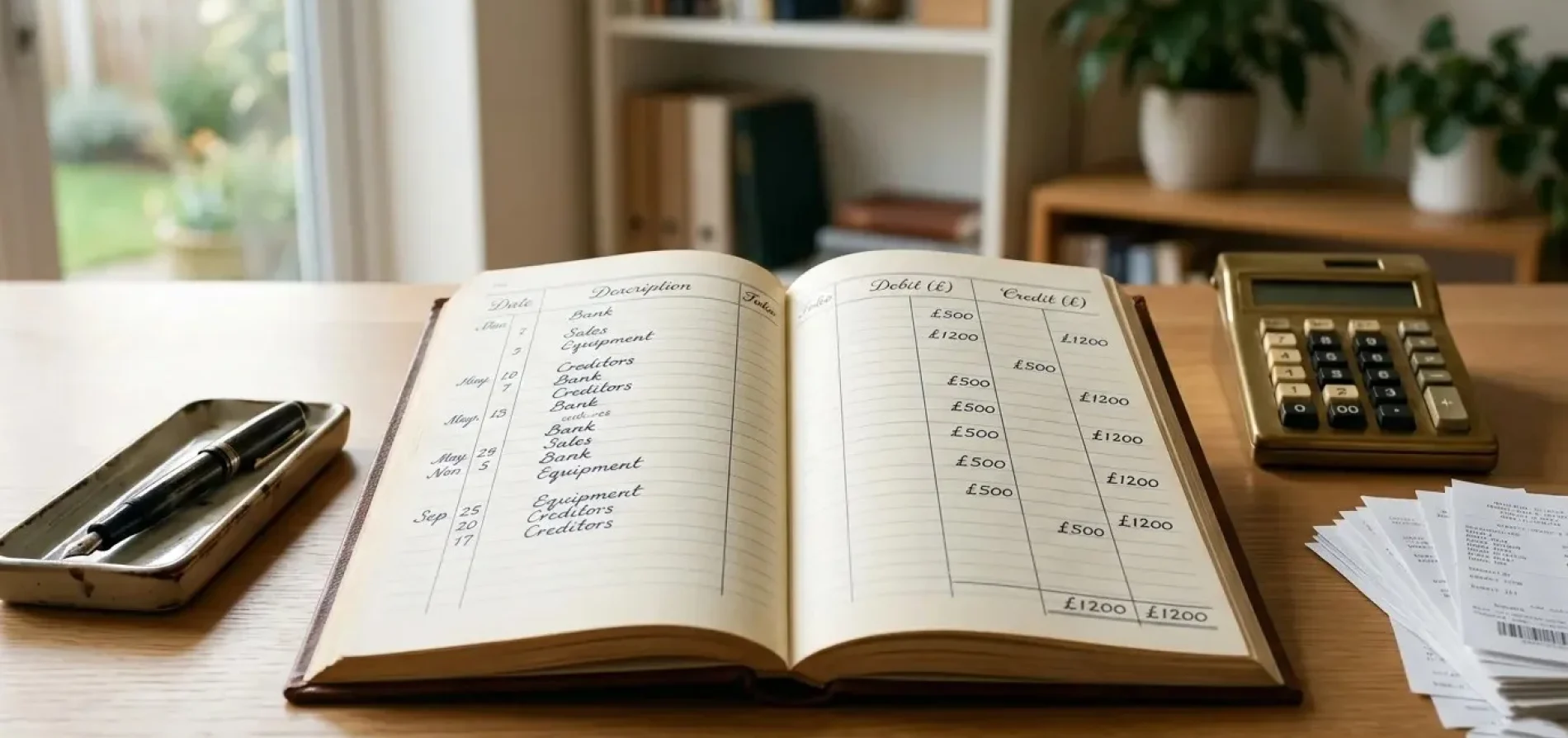
Double entry bookkeeping is a way of recording business transactions so that every entry has two sides. One side is entered as a debit, and the other is entered as a credit. The purpose is to keep your records balanced and make sure your accounts reflect what is really happening in the business.
At the centre of double entry bookkeeping is the core accounting equation:
Assets = Liabilities + Equity
When each transaction is recorded properly, that equation stays balanced. This gives your business a more reliable bookkeeping system, helps reduce errors, and provides a clearer view of your finances than simple record-keeping methods.
What does double entry bookkeeping mean?
Double-entry bookkeeping is the standard global system used by businesses across the world, including the UK. Every financial transaction affects at least two accounts.
For each transaction, you record:
- a debit in one account
- a matching credit in another account
This two-sided method keeps the books balanced. Whether you are getting paid by a customer, paying a supplier, buying equipment, or taking out finance, both sides of the transaction are recorded.
For UK businesses, accurate bookkeeping is essential. HMRC expects records to clearly show income, costs, assets, and liabilities. Double entry bookkeeping creates the structure needed to support this and helps businesses stay organised for tax reporting and Making Tax Digital requirements.
Why double entry bookkeeping matters
Double entry bookkeeping is not just an accounting rule. It is the foundation of proper financial reporting.
By recording both sides of each transaction, it helps businesses keep more accurate records, spot mistakes earlier, and understand their real financial position with more confidence.
In practical terms, double entry bookkeeping helps you:
- track what the business owns
- track what the business owes
- see what belongs to the owner or shareholders
- prepare accurate profit and loss reports
- produce a correct balance sheet
- reconcile bank transactions properly
- keep cleaner records for VAT, year-end accounts, and tax returns
As UK tax reporting becomes more digital, organised records matter even more. A strong bookkeeping system makes compliance smoother and gives you a better platform for day-to-day decision-making.
For limited companies, double entry bookkeeping is essential for producing proper accounts. Even for sole traders and partnerships, it provides a far stronger base than basic money-in, money-out tracking.
- The main account types in double entry bookkeeping
Every double entry system works through a chart of accounts. This is simply a structured list of categories used to record transactions.
Although the exact setup can vary depending on the business and software used, most businesses work with five main account types.
1. Assets
Assets are things the business owns or controls that have value.
Examples include:
- bank accounts
- cash
- trade debtors
- stock
- computers
- machinery
- equipment
Assets usually increase with a debit entry.
2. Liabilities
Liabilities are amounts the business owes to others.
Examples include:
- suppliers
- VAT owed
- business loans
- PAYE and National Insurance liabilities
Liabilities usually increase with a credit entry.
3. Equity
Equity shows the owner’s or shareholders’ interest in the business after liabilities are deducted from assets.
Typical equity accounts may include:
- share capital
- retained profits
- director’s loan account
Equity usually increases with a credit entry.
4. Income
Income accounts show what the business earns through trading and other receipts.
Examples include:
- sales income
- consultancy income
- service revenue
- interest received
Income usually increases with a credit entry.
5. Expenses
Expenses are the costs of running the business.
Examples include:
- rent
- utilities
- wages
- travel
- software
- marketing
Expenses usually increase with a debit entry.
Why the chart of accounts matters
A well-organised chart of accounts makes bookkeeping easier to manage and easier to understand.
It supports:
- clearer management reporting
- more accurate VAT returns
- smoother year-end accounts
- better visibility over performance
Most modern cloud accounting systems come with a standard chart of accounts for UK businesses, which can then be adjusted to suit your industry and reporting needs.
Debits and credits explained simply
Debits and credits are often the part that makes double entry bookkeeping sound difficult, but they are simply a way of showing how value moves between accounts.
A simple way to think about them is:
- Debit records value entering an account
- Credit records value leaving an account
The effect depends on the type of account involved.
For routine transactions, these are the patterns to remember:
- assets: debit increases, credit decreases
- liabilities: credit increases, debit decreases
- equity: credit increases, debit decreases
- income: credit increases, debit decreases
- expenses: debit increases, credit decreases
A useful shortcut is this:
- expenses are commonly debits
- sales and income are commonly credits
Most accounting software handles the technical side in the background, but understanding the basics helps you review entries properly and spot problems sooner.
Double entry vs single entry bookkeeping
Single entry bookkeeping is a more basic method. It usually records money coming in and money going out, much like a cashbook.
That can work for very simple setups, but it has limitations once a business grows or needs more formal reporting.
Double entry bookkeeping is more complete because it records both sides of every transaction and shows which accounts are affected.
Why double entry gives a better picture
Because the full transaction is recorded, double entry bookkeeping helps you:
- measure actual profit instead of just cash movement
- track customer balances and supplier balances
- prepare reliable reports for VAT, tax, and year-end accounts
- understand the true financial position of the business
Single entry focuses mainly on cash. Double entry reflects the wider financial reality.
For VAT-registered businesses, limited companies, and businesses planning to grow, double entry bookkeeping is the stronger and more reliable approach.
Simple double entry bookkeeping examples
The easiest way to understand double entry bookkeeping is to see it in practice.
Example 1: Cash sale
You provide a service for £500 and the customer pays straight into your business bank account.
The entry would be:
- Debit: Bank £500
- Credit: Sales £500
Your bank balance goes up and your income is recognised. The books stay balanced.
Example 2: Buying equipment on credit
You buy equipment costing £1,200 from a supplier, but you do not pay immediately.
The entry would be:
- Debit: Equipment £1,200
- Credit: Trade creditors £1,200
This shows that the business now owns the equipment and also owes the supplier the same amount.
Paying the supplier later
When you later pay the supplier from your bank account, you record:
- Debit: Trade creditors £1,200
- Credit: Bank £1,200
This clears the liability and reduces your bank balance.
These examples show why double entry bookkeeping gives a more complete picture than simply recording when money leaves or enters the bank.
Where double entry records are kept
Double entry bookkeeping also relies on a structure for storing and checking transactions.
Journals
A journal is the first place a transaction is recorded. It shows both the debit and the matching credit together.
This creates a clear audit trail and shows:
- what happened
- when it happened
- which accounts were affected
Ledgers
Ledger accounts build up the running balance for each category in your chart of accounts. So rather than seeing one isolated transaction, you can see the full movement over time in bank, sales, expenses, VAT, creditors, and other accounts.
Trial balance
A trial balance is used to check that the total debits equal the total credits across the system.
It does not guarantee every posting is correct, but it is an important accuracy check and helps identify bookkeeping errors before accounts are prepared.
Why good double entry bookkeeping matters for growing businesses
When your bookkeeping is built on proper double entry principles, it becomes much easier to:
- stay organised for VAT and tax filings
- prepare year-end accounts accurately
- understand profitability
- monitor cash flow
- track liabilities
- make better decisions using reliable figures
It also helps your accountant work more efficiently, which can save time, reduce corrections, and improve the quality of advice you receive.
Final thoughts
Double entry bookkeeping is the foundation of proper business accounting. It makes sure every transaction is recorded in a balanced way, supports accurate reporting, and helps businesses stay compliant and informed.
While the terms debit and credit can seem intimidating at first, the logic behind the system is straightforward once you understand how the different account types behave.
For a small business, getting double entry bookkeeping right means more than tidy records. It means better visibility, fewer mistakes, smoother compliance, and stronger financial control.