There is no single “small business tax return” that applies to every UK business. What you need to file depends mainly on how your business is structured.
A sole trader normally reports business profits through Self Assessment. A partnership normally files a Partnership Tax Return, while each individual partner reports their share of the profits on their own Self Assessment return. A limited company has different obligations and may need to file a Company Tax Return with HMRC as well as annual accounts with Companies House.
This guide explains which return applies to each type of small business, the main filing deadlines, what records you should keep, how Making Tax Digital affects some businesses and where to get help.
Which Tax Return Does a Small Business Need?
| Business structure | Main filing / reporting obligation |
|---|---|
| Sole trader | Self Assessment tax return |
| Partnership | Partnership Tax Return plus individual partners’ Self Assessment returns |
| Limited company | Company Tax Return plus annual accounts |
| VAT-registered business | VAT returns are separate from the annual business tax return |
| Employer | PAYE reporting is separate from the annual business tax return |
The important point is that the phrase “small business tax return” can mean different things depending on the legal structure of the business.
A sole trader is taxed personally on business profits through Self Assessment. HMRC says a sole trader will normally need to send a Self Assessment tax return where gross trading income is more than £1,000 in the tax year.
A partnership normally files an SA800 Partnership Tax Return. The partnership itself does not generally pay Income Tax on the partnership profits; instead, each partner includes their allocated share of partnership income or losses on their own tax return.
Limited companies operate under Corporation Tax rules. A company that has been issued a Notice to Deliver a Company Tax Return must file the return for the relevant accounting period.
Small Business Tax Return Deadlines
The filing deadline depends on your business structure.
Sole traders
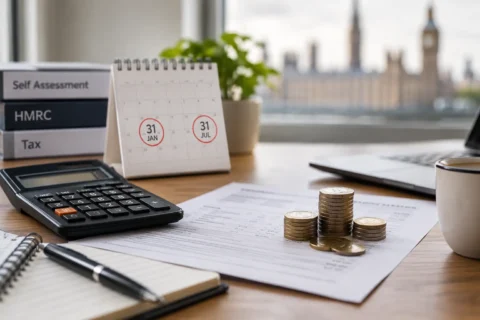
For the 2025/26 tax year, the main Self Assessment deadlines are:
31 October 2026 — paper return deadline
31 January 2027 — online return deadline
31 January 2027 — normal tax payment deadline
31 July 2027 — second payment on account, where applicable
If you are newly required to notify HMRC, the normal notification deadline is 5 October 2026 where the relevant conditions apply.
Read: Self Assessment tax return deadlines
Partnerships
Partnership returns generally follow the Self Assessment timetable where the partners are individuals. The normal online filing deadline is 31 January following the end of the tax year. Different rules can apply where a partnership has a limited company as a partner.
Limited companies
Limited companies work to different deadlines.
A Company Tax Return is normally due 12 months after the end of the Corporation Tax accounting period.
Corporation Tax is normally payable earlier, 9 months and 1 day after the end of the accounting period.
Annual accounts for an established private limited company are normally due to Companies House 9 months after the company’s financial year ends. First accounts generally have a different deadline of 21 months after incorporation.
Read: How to file Company Tax Returns in the UK
What Records Should a Small Business Keep?
Good record keeping is essential regardless of the business structure.
Depending on your business, useful records may include:
- sales invoices and other income records
- purchase invoices and receipts
- business bank statements
- records of allowable business expenses
- payroll records
- VAT records where registered
- details of business assets
- loan and finance records
- records supporting tax reliefs or allowances
The exact records you need depend on whether you operate as a sole trader, partnership or limited company and on the taxes that apply to the business.
Good bookkeeping throughout the year can make preparing tax returns and accounts significantly easier.
How Does a Sole Trader File a Small Business Tax Return?
Sole traders generally report their business income and expenses through Self Assessment.
You normally report your gross business income, deduct allowable business expenses or use the trading allowance where eligible, and calculate your taxable business profit.
Your Self Assessment return may also include other taxable income such as employment income, property income, savings, dividends or capital gains depending on your circumstances.
Sole traders with more than £1,000 of gross trading income will normally need to register for Self Assessment, subject to the relevant exceptions.
Read: Self Assessment for sole traders
Need help? Speak to a Self Assessment Accountant
How Does a Partnership File a Tax Return?
A business partnership has a different filing process from a sole trader.
The partnership normally files an SA800 Partnership Tax Return, which reports the partnership’s income, expenses, profits or losses and how those amounts are allocated between the partners.
Each individual partner then reports their own share of the partnership income or loss on their personal Self Assessment tax return.
The partnership itself generally does not pay Income Tax on the partnership profits. The tax position is dealt with at partner level.
How Does a Limited Company File a Tax Return?
A limited company does not file a sole-trader Self Assessment return for its business profits.
Where HMRC requires a Company Tax Return, the company normally submits a CT600 together with the required accounts, tax computations and any relevant supplementary information.
From 1 April 2026, HMRC’s former online service for filing company accounts and Company Tax Returns is no longer available. Companies should now use commercial software to file Company Tax Returns with HMRC. Paper returns are generally only permitted where there is a reasonable excuse or the return is being filed in Welsh.
Companies House accounts are a separate filing obligation, even though some commercial software can support both submissions.
Read: How to file Company Tax Returns in the UK
Need help? Speak to a Corporation Tax Accountant
Are VAT Returns and PAYE Returns the Same as a Business Tax Return?
No. VAT and PAYE reporting are separate obligations.
A VAT-registered business may need to submit VAT returns in addition to its annual Self Assessment, Partnership Tax Return or Company Tax Return.
Businesses that employ staff may also have PAYE and Real Time Information reporting obligations.
These filings should not be confused with the annual tax return for the business or its owners.
How Does Making Tax Digital Affect Small Businesses?
Making Tax Digital for Income Tax currently affects qualifying individuals with self-employment or property income rather than every type of small business.
You need to use Making Tax Digital for Income Tax from 6 April 2026 if qualifying income shown on your 2024/25 tax return was more than £50,000.
The threshold then expands to:
- more than £30,000 from 6 April 2027
- more than £20,000 from 6 April 2028
Qualifying income is broadly gross income from self-employment and property before expenses and tax.
Limited companies are not brought into Making Tax Digital for Income Tax simply because they are small businesses. HMRC also states that partnerships will come into MTD for Income Tax in the future, but the partnership timetable has not yet been set.
Read: Making Tax Digital for Income Tax
Common Small Business Tax Return Mistakes
Common problems often come from treating all small businesses as if they have the same filing requirements.
Watch out for:
- using Self Assessment rules for a limited company
- confusing the Corporation Tax payment deadline with the Company Tax Return filing deadline
- forgetting that Companies House accounts and the Company Tax Return are separate obligations
- failing to report all taxable business income
- claiming private or non-allowable expenses
- leaving bookkeeping until the filing deadline
- missing VAT or PAYE obligations because they are separate from the annual tax return
- using outdated tax-year thresholds or deadlines
The correct filing process always depends on the business structure and the taxes that apply.
Do Small Businesses Need an Accountant for Tax Returns?
There is no general requirement for every small business to use an accountant to prepare a tax return.
However, professional support can be useful where your business has multiple income streams, VAT registration, employees, a limited-company structure, complex expenses, tax relief claims, losses, Making Tax Digital requirements or incomplete accounting records.
The most important first step is identifying which return actually applies to your business structure.
Small business support: Small Business Accountants in London
Self Assessment: Speak to a Self Assessment Accountant
Limited companies: Speak to a Corporation Tax Accountant
Frequently Asked Questions About Small Business Tax Returns
Do all small businesses file Self Assessment?
No. Sole traders normally use Self Assessment, while partnerships file a Partnership Tax Return and individual partners also report their share through Self Assessment. Limited companies normally deal with business profits through Corporation Tax and Company Tax Returns.
Does a sole trader need to file a tax return?
A sole trader will normally need to send a Self Assessment tax return where gross trading income is more than £1,000 in the tax year, although exceptions and other filing reasons can apply.
Does a limited company file Self Assessment?
The company itself does not use Self Assessment to report its business profits. A limited company may need to file a Company Tax Return with HMRC. Directors may separately need Self Assessment depending on their own personal tax circumstances.
What is the deadline for a Company Tax Return?
A Company Tax Return is normally due 12 months after the end of the Corporation Tax accounting period. Corporation Tax is normally payable earlier, 9 months and 1 day after the accounting period ends.
Do small businesses need commercial software to file Corporation Tax?
From 1 April 2026, companies generally need commercial software to file Company Tax Returns with HMRC because HMRC’s former joint online filing service closed on 31 March 2026.
Does Making Tax Digital apply to every small business?
No. MTD for Income Tax currently applies to qualifying individuals with self-employment or property income. The threshold is being introduced in stages from April 2026. Partnerships are expected to join later, but HMRC has not yet set their timetable.
Get Help With Your Small Business Tax Return
Small business tax obligations become much easier to manage once you know which filings apply to your business structure and when they are due.
Accounting People supports sole traders, partnerships and limited companies with tax returns, accounts, bookkeeping, VAT and wider compliance requirements.
If you are unsure which return your business needs or would like help preparing and submitting it, speak to our team.