If you work for yourself as a sole trader, you may need to complete a Self Assessment tax return to report your business income and expenses to HMRC.
Sole traders with more than £1,000 of gross trading income in a tax year will normally need to register for Self Assessment and report their income. Different rules can apply where income is £1,000 or less, and you may also need a tax return because of other income or tax circumstances.
This guide explains Self Assessment for sole traders, including when you need to register, what goes on the tax return, allowable business expenses, how taxable profits are calculated, National Insurance, record keeping, payments on account and Making Tax Digital.
If you would prefer professional help preparing and submitting your return, our Self Assessment accountants can support you.
Currently filing your 2025/26 tax return?
The tax year ended on 5 April 2026. Under the current HMRC timetable:
5 October 2026 — normal notification/registration deadline where applicable
31 October 2026 — paper return deadline
31 January 2027 — online return deadline
31 January 2027 — payment deadline
If you register after 5 October 2026, HMRC says it will normally give you a different filing deadline of three months from its letter or email, but tax due is still payable by 31 January 2027.
Do Sole Traders Need to File a Self Assessment Tax Return?
You normally need to send a Self Assessment tax return if you were self-employed as a sole trader and earned more than £1,000 in gross trading income during the tax year.
“Gross” means the income before deducting expenses or tax reliefs.
If gross trading income is £1,000 or less, the trading allowance may mean you do not need to report that income. However, exceptions apply and there are circumstances where you may still need or choose to register.
You may also need Self Assessment because of other income or tax circumstances, even if your sole-trader income alone does not create the requirement.
How Do You Register for Self Assessment as a Sole Trader?
You register as a sole trader with HMRC by registering for Self Assessment.
HMRC says registration is required in several circumstances, including where your gross trading income is more than £1,000 in a tax year. Registration may also be required if you need to prove you are self-employed, want to make voluntary Class 2 National Insurance contributions, or need to register as a CIS subcontractor.
Under the current timetable, where you need to complete a return for the previous tax year and are newly required to file, the usual notification deadline is 5 October.
Read: How to register for Self Assessment
What Goes on a Sole Trader Self Assessment Tax Return?
Your return will include information HMRC needs to calculate your taxable income and tax position.
For your sole-trader business, this will normally include your business income, allowable expenses and the resulting profit or loss.
Depending on your circumstances, you may also need to report other taxable income, such as employment income, property income, savings, dividends, foreign income or relevant capital gains.
The exact sections you complete depend on your circumstances.
What Expenses Can Sole Traders Claim?
Sole traders can deduct allowable business expenses when calculating taxable profit.
HMRC lists categories including office costs, business travel, staff costs, stock and materials, financial costs, business premises, advertising and qualifying training costs.
Expenses must meet the relevant tax rules, and private expenditure is not deductible simply because it was paid from a business account.
If you use the £1,000 trading allowance, you cannot also claim actual business expenses against the same trading income.
Read our full guide to allowable business expenses for the self-employed.
How Is Sole Trader Profit Calculated for Self Assessment?
Your taxable business profit broadly starts with business income minus allowable business expenses, with further tax adjustments applying where relevant.
Cash basis is now the standard accounting method for eligible sole traders and partnerships without corporate partners. Under cash basis, you generally record income when you receive it and expenses when you pay them.
You can choose traditional accounting instead. Traditional accounting generally records income and expenses based on when they are earned or incurred rather than simply when money is received or paid.
What if your accounting year does not match the tax year?
From the 2024/25 tax year onwards, sole traders are taxed on business profits arising in the tax year itself.
If your accounting year does not end between 31 March and 5 April, you may need to apportion profits from more than one set of accounts when preparing your Self Assessment return.
Sole traders can continue to choose their own accounting date, although using 31 March or 5 April can simplify the calculation for many businesses.
How Is a Sole Trader Taxed?
Sole traders pay tax on taxable business profits rather than simply on turnover.
Your final Income Tax position can also depend on other taxable income you receive during the year and any allowances or reliefs available to you.
Income Tax bands depend on the relevant tax year and, for non-savings and non-dividend income, different rates apply to Scottish taxpayers.
| Current 2026/27 position | Rate / amount |
|---|---|
| Standard Personal Allowance | £12,570 |
| Basic rate Income Tax* | 20% |
| Higher rate Income Tax* | 40% |
| Additional rate Income Tax* | 45% |
| Class 4 NI on profits over £12,570 up to £50,270 | 6% |
| Class 4 NI on profits over £50,270 | 2% |
The Income Tax rates above apply to England, Wales and Northern Ireland. Different Income Tax bands and rates apply to Scottish taxpayers. The Personal Allowance can also be reduced where adjusted net income exceeds £100,000.
If you are preparing a return for an earlier tax year, use the rates and thresholds that applied to that specific year.
If you also receive dividends, savings income or other taxable income, these may need to be reported separately on your Self Assessment return.
Do Sole Traders Still Pay Class 2 National Insurance?
Most self-employed people no longer make compulsory Class 2 National Insurance payments.
For 2026/27, if your self-employed profits are £7,105 or more, Class 2 contributions are treated as having been paid for the purpose of protecting your National Insurance record. This means there is normally no Class 2 payment to make.
If your profits are below £7,105, you do not have to pay Class 2, although you may be able to make voluntary Class 2 contributions to help protect your National Insurance record.
Class 4 National Insurance is separate and is payable where relevant profits exceed £12,570.
What Records Should a Sole Trader Keep?
You should keep enough business records to support the figures included in your Self Assessment tax return.
Depending on your business and circumstances, these may include:
- records of sales and other business income
- invoices and receipts
- records of allowable business expenses
- business bank records
- VAT records if you are VAT registered
- PAYE records if you employ staff
- CIS records where relevant
- details of business assets
- evidence supporting allowances or reliefs you claim
You do not normally send these records with your Self Assessment return, but HMRC can ask to see them.
Self-employed taxpayers must normally keep their business records for at least five years after the 31 January submission deadline for the relevant tax year.
For a wider checklist covering income, expenses, employment documents, property income and other tax records, see our Self Assessment records checklist.
Good bookkeeping throughout the year can make preparing your tax return considerably easier and reduce the risk of missing income or expenses.
For current registration, filing and payment dates, see our Self Assessment deadline guide.
What Are Payments on Account for Sole Traders?
Payments on account are advance payments towards your next Self Assessment tax bill. For self-employed taxpayers, they can also include Class 4 National Insurance.
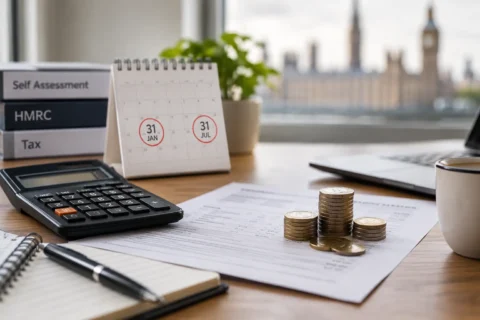
They are normally paid in two instalments:
- 31 January
- 31 July
You will not normally need to make payments on account if your previous Self Assessment tax bill was less than £1,000, or if more than 80% of the tax you owed was collected outside Self Assessment.
Each payment is normally half of the previous year’s relevant tax liability.
Payments on account can make the January bill larger than expected because you may be paying both a balancing payment for the previous year and an advance payment towards the next year.
Read our full guide to Payments on Account.
How Does Making Tax Digital Affect Sole Traders?
Making Tax Digital for Income Tax is now in operation for the first mandatory group of sole traders and landlords.
You need to use Making Tax Digital for Income Tax from 6 April 2026 if your qualifying income shown on your 2024/25 tax return was more than £50,000.
The rollout then expands to:
- qualifying income of more than £30,000 from 6 April 2027
- qualifying income of more than £20,000 from 6 April 2028
Qualifying income is broadly your total gross income from self-employment and property before expenses and tax.
If MTD applies to you, you need compatible software to keep digital records, send quarterly updates to HMRC and submit your tax return under the MTD rules.
Read more about Making Tax Digital for Income Tax.
Do Sole Traders Need an Accountant for Self Assessment?
You are not legally required to use an accountant simply because you are a sole trader. You can prepare and submit your own Self Assessment tax return.
An accountant may be useful where you have several sources of income, incomplete records, uncertainty over allowable expenses, payments on account, a non-standard accounting period or Making Tax Digital requirements.
Accounting People can review the information you provide, prepare your return, explain the tax calculation and submit the return to HMRC where you have authorised us to act.
Speak to a Self Assessment Accountant
Get Help With Your Sole Trader Self Assessment
Self Assessment is easier to manage when your records are organised, your filing requirements are clear and you understand what tax may be due.
Accounting People supports sole traders with Self Assessment preparation, tax calculations, allowable expenses, payments on account and HMRC submission.
If you need help preparing your return, speak to our Self Assessment team.
Get Help With Your Self Assessment