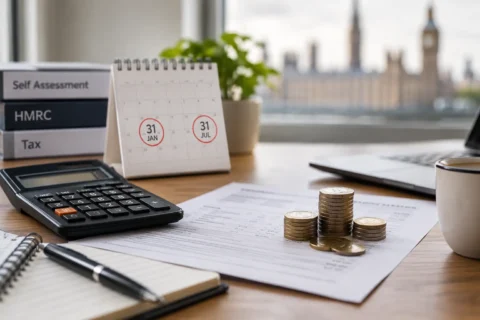

The Self Assessment deadline can arrive quickly if records, HMRC access or payment planning are left until January.
For the 2025/26 tax year, the standard online Self Assessment filing deadline is 31 January 2027. Tax due through Self Assessment is also generally payable by 31 January 2027.
The deadline can affect sole traders, landlords, freelancers, people with untaxed income and others who are required to complete a Self Assessment tax return. Whether you need to file depends on your individual circumstances rather than your job title alone.
Missing documents, incomplete records, HMRC login problems and unexpected payments on account can all make last-minute filing more difficult.
If you are getting ready to file, use our Self Assessment records checklist to see what information and documents you may need.
This guide explains the main Self Assessment deadlines for the 2025/26 tax year, who may need to file, what happens if a return or payment is late, what records you may need and why preparing early can make the process easier.
If you want help preparing and filing your return, Accounting People provides practical support through our Self Assessment accountant service.
What Is the January Tax Return Deadline in the UK?
When people refer to the January tax return deadline, they usually mean the deadline for submitting an online Self Assessment tax return to HMRC.
For the 2025/26 tax year, which ran from 6 April 2025 to 5 April 2026, the standard online filing deadline is:
31 January 2027
This is also generally the deadline for paying any Self Assessment tax due for the 2025/26 tax year.
However, 31 January is not the only date that matters. Registration, paper filing and payments on account have separate deadlines.
Key Self Assessment Deadlines for 2025/26
The main standard deadlines are:
| Deadline | What it means |
|---|---|
| 5 October 2026 | Tell HMRC if you need to complete a return for 2025/26 and you have not previously filed, or you were previously registered but did not need to file for 2024/25 |
| 31 October 2026 | Standard deadline for paper Self Assessment tax returns |
| 30 December 2026 | Online filing deadline if you want HMRC to consider collecting an eligible Self Assessment bill through your PAYE tax code |
| 31 January 2027 | Standard online Self Assessment tax return deadline |
| 31 January 2027 | Standard deadline to pay Self Assessment tax due |
| 31 July 2027 | Second payment on account, where applicable |
For taxpayers filing online under the standard timetable, 31 January 2027 is the key filing and payment date.
Different deadlines can apply in certain circumstances. For example, if you register for Self Assessment after 5 October 2026, HMRC may give you a different filing deadline. The tax itself may still need to be paid by 31 January 2027.
You can check the latest deadlines directly through HMRC’s Self Assessment deadline guidance.
Paying through your PAYE tax code
Some taxpayers who already pay tax through PAYE may be able to have an eligible Self Assessment bill collected through their tax code.
For this to be considered, you normally need to submit your online return by 30 December 2026.
Other conditions also apply, including generally owing less than £3,000 and having enough PAYE income for HMRC to collect the amount through your tax code.
What Tax Year Does the January 2027 Deadline Cover?
This is a common source of confusion.
The 31 January 2027 deadline relates to the 2025/26 tax year, not the tax year running during January 2027.
The relevant period is:
6 April 2025 to 5 April 2026
That means your Self Assessment return may need to include relevant income, expenses, gains and other information relating to that period.
Using records from the wrong tax year can lead to an incorrect return, so it is important to identify the correct period before preparing your figures.
Who May Need to File a Self Assessment Tax Return?
Not everyone in the UK needs to complete a Self Assessment tax return. Tax on employment and pension income is often collected automatically through PAYE.
For the 2025/26 tax year, you will generally need to send a Self Assessment return if, among other circumstances:
- you were self-employed as a sole trader with more than £1,000 of gross trading income
- you were a partner in a business partnership
- you had Capital Gains Tax to pay
- you need to pay the High Income Child Benefit Charge and it is not being collected through PAYE
- another specific Self Assessment filing requirement applies to you
You may also need to file if you receive untaxed income from sources such as:
- property or land
- tips or commission
- savings interest
- dividends
- foreign income
- certain other taxable income
Being a company director does not automatically mean that you need to complete a Self Assessment tax return. A director may still need to file where another filing requirement applies, for example because of dividends or other untaxed income.
HMRC provides an online service to check whether you need to send a Self Assessment tax return.
If you work for yourself, you can also read our guide to Self Assessment tax returns for sole traders.
Why the 31 January Deadline Matters
The 31 January deadline can involve two separate obligations.
First, it is normally the deadline for submitting your online Self Assessment tax return.
Second, it is generally the deadline for paying the Self Assessment tax you owe.
This means January is not only about completing a return. You also need to understand the amount that may need to be paid.
This is where some taxpayers experience an unexpected cash-flow problem. They prepare their return close to the deadline and then discover that the amount due is higher than expected.
For some taxpayers, the January bill may also include a first payment on account towards the next tax year.
Preparing the return earlier can give you more time to understand your tax position and plan for the payment.
What Happens If You Miss the January Tax Return Deadline?
If you are required to file and miss the Self Assessment filing deadline, an initial £100 late-filing penalty can apply.
Importantly, the initial penalty can apply even if you have no tax to pay or have already paid the tax you owe.
If the return remains outstanding, further penalties can arise.
Under the current rules:
- an initial £100 late-filing penalty can apply
- after 3 months, additional daily penalties of £10 per day can apply
- those daily penalties can continue for up to 90 days, giving a maximum additional penalty of £900
- after 6 months, a further penalty can apply
- after 12 months, another penalty can apply
Late payment is treated separately from late filing.
If Self Assessment tax remains unpaid, late-payment penalties can arise at 30 days, 6 months and 12 months after the payment deadline.
HMRC can also charge interest on overdue tax.
You can review the current rules on Self Assessment penalties on GOV.UK.
The important point is that filing the return and paying the tax are separate obligations. Filing late can create a penalty even where no tax is outstanding.
What Do You Need Before Filing Your Tax Return?
The information required depends on your circumstances and the income you received during the tax year.
You may need records relating to:
- self-employment income
- invoices and sales records
- allowable business expenses
- bank statements
- employment income, including P60 or P45 information where relevant
- rental income and property expenses
- savings interest
- dividends and investments
- pension contributions
- Gift Aid donations
- foreign income
- relevant capital gains
- student loan information
- Child Benefit information where relevant
- payments on account already made
Not everybody will need every document on this list.
The important thing is to identify which income sources and tax circumstances apply to you and collect the records relating to them.
For self-employed people and businesses, organised bookkeeping throughout the year can make preparing a tax return significantly easier.
Our cloud accountancy services can help businesses maintain digital accounting records rather than trying to reconstruct everything close to the filing deadline.
Check Your HMRC Access Before January
Do not wait until the final days before the deadline to discover that you cannot access the relevant HMRC services.
Before you need to file, check that you have the information and access you may require.
Depending on your circumstances, this may include your:
- Unique Taxpayer Reference
- National Insurance number
- HMRC sign-in details
- previous tax return information
- Self Assessment statements
- payments on account information
HMRC access issues can take time to resolve, so checking early reduces the risk of an avoidable problem near the deadline.
You can also read our guide explaining your HMRC Personal Tax Account and what you can use it for.
Why People Leave Self Assessment Until January
Tax returns often get delayed because other things feel more urgent.
A sole trader may be serving customers.
A landlord may be managing properties.
A freelancer may be completing projects and chasing invoices.
A business owner may be concentrating on sales, staff and cash flow.
Self Assessment becomes something to deal with later.
The problem is that leaving everything until January reduces the time available to resolve missing information, accounting questions or HMRC access problems.
The return itself may be manageable, but unnecessary time pressure makes the process more difficult.
Preparing earlier gives you more time to:
- identify missing records
- check your figures
- understand potentially allowable expenses
- review the tax calculation
- understand payments on account
- plan for the payment deadline
- deal with HMRC access problems
Self Assessment Deadline Checklist
Before the January deadline, check the following:
- Confirm whether you need to file a Self Assessment tax return
- Register with HMRC where required
- Check your Unique Taxpayer Reference
- Confirm you can access the relevant HMRC services
- Gather income records for the correct tax year
- Gather relevant expense records
- Review employment income where relevant
- Review property income
- Review dividends and savings income
- Review foreign income where relevant
- Check relevant pension contributions
- Check Gift Aid donations
- Review capital gains information where applicable
- Check previous payments on account
- Review your tax calculation
- Confirm your filing deadline
- Confirm your payment deadline
- Make sure the return is submitted where required
- Make arrangements to pay the amount due
What Are Payments on Account?
Payments on account are advance payments towards your next Self Assessment tax bill.
They are normally made in two instalments:
- the first payment is due on 31 January
- the second payment is due on 31 July
Each payment is generally half of the previous year’s relevant Self Assessment tax liability.
You will not normally need to make payments on account if either:
- your previous Self Assessment tax bill was less than £1,000, or
- more than 80% of the tax you owed was collected outside Self Assessment, for example through PAYE
Where payments on account apply, the January amount can therefore be larger than expected.
You may need to pay:
- any balancing payment still due for the previous tax year
- your first payment on account towards the following tax year
A second payment on account may then be due on 31 July.
This is one reason why filing earlier can be useful. It gives you more time to understand how much may be payable rather than discovering the amount shortly before 31 January.
You can read HMRC’s detailed guidance on payments on account.
If you run a business, our small business accountants can also help you maintain clearer accounting records and plan for upcoming tax liabilities.
Side Hustles and Self Assessment
Income from a side activity can also create Self Assessment obligations.
Examples may include income from:
- freelancing
- online selling
- tutoring
- delivery work
- content creation
- affiliate activity
- consulting
- coaching
- casual services
- selling handmade products
The £1,000 trading allowance may be relevant where you receive trading or certain miscellaneous income from side activities.
If your total annual gross trading income from one or more trades is more than £1,000, you will generally need to tell HMRC and register for Self Assessment if you are not already registered.
If gross trading income is £1,000 or less, you may not need to tell HMRC, although exceptions apply and there are circumstances where completing Self Assessment may still be necessary or beneficial.
The important distinction is that the £1,000 test relates to gross income before deducting expenses, not profit.
Property income has its own separate £1,000 property allowance, subject to its own conditions.
You can read the current HMRC guidance on trading and property allowances.
Can You File Your Tax Return Before January?
Yes.
You do not need to wait until January to file a Self Assessment return.
Once the tax year has ended and you have the information required, you can usually prepare and submit the return earlier.
Filing early does not normally bring forward the standard 31 January payment deadline.
It can, however, tell you how much you owe much sooner.
That can provide several benefits:
- more time to budget
- more time to review the figures
- more time to resolve missing information
- earlier clarity on payments on account
- less pressure close to the deadline
- more time to arrange payment
For the 2025/26 tax year, the tax year ended on 5 April 2026, while the standard online filing and payment deadline is not until 31 January 2027.
That gives taxpayers a significant period in which to prepare rather than waiting until the final weeks.
Does Making Tax Digital Change the 31 January 2027 Deadline?
Making Tax Digital for Income Tax began applying to some qualifying taxpayers from 6 April 2026.
However, this does not replace the normal Self Assessment return for the 2025/26 tax year.
Taxpayers entering Making Tax Digital for Income Tax from 6 April 2026 still submit their 2025/26 Self Assessment tax return in the usual way by 31 January 2027.
Making Tax Digital obligations from 6 April 2026 relate to the 2026/27 tax year and later reporting requirements.
If you are affected by the new system, visit our Making Tax Digital accountants page for more information about preparing your accounting records and reporting processes.
Common Self Assessment Mistakes to Avoid
Leaving a tax return until the last minute can increase the likelihood of mistakes.
Some common issues include:
Using the Wrong Tax Year
The 31 January 2027 deadline relates to income and relevant activity during the 2025/26 tax year, from 6 April 2025 to 5 April 2026.
Make sure you are using records from the correct period.
Missing Income
Depending on your circumstances, a return may need to include more than self-employment income.
Property income, savings interest, dividends, foreign income and other taxable income may also be relevant.
Claiming Expenses Without Checking the Rules
Not every cost is automatically deductible for tax purposes.
For self-employed people, expenses generally need to meet the relevant tax rules, and private use may need to be considered where a cost has both business and personal elements.
Forgetting Payments on Account
The amount payable on 31 January may include more than the final tax due for the previous year.
A first payment on account for the following year may also be payable.
Leaving HMRC Access Until the Last Minute
Problems accessing your HMRC account or locating your UTR can create unnecessary pressure close to the filing deadline.
Filing Without Reviewing the Calculation
Before approving or submitting a return, review the information included and understand the resulting tax calculation.
If something looks unexpected, it is better to investigate it before submission rather than assume the figure must be correct.
How an Accountant Can Help Before the January Deadline
An accountant can help organise the Self Assessment process where your circumstances require additional support.
Depending on the work agreed, an accountant may be able to:
- review whether Self Assessment may be required
- help with Self Assessment registration where needed
- review income and expense information
- consider potentially allowable business costs
- review relevant income sources
- explain payments on account where applicable
- prepare the tax return
- review the tax calculation
- submit the return to HMRC where authorised
- explain filing and payment deadlines
- support better record keeping for future returns
This can be particularly useful where you have several sources of income, self-employment, rental property, dividends or other circumstances that make the return less straightforward.
How Accounting People Can Help
Accounting People supports sole traders, landlords, freelancers, company directors and other individuals who need help with Self Assessment.
Our accounting team can help organise the information needed for your return, review relevant income and expenses, prepare the tax calculation and, where authorised, submit the completed return to HMRC.
We can also explain filing and payment deadlines, payments on account and the information you may need to retain for future returns.
Accounting People supports clients across the UK, with in-person meetings available at our Stanmore office where required.
If you need help before the January deadline, our Self Assessment accountant service provides practical accounting support across the UK.
Final Thoughts
The 31 January Self Assessment deadline is straightforward to remember, but leaving everything until January can create unnecessary pressure.
For the 2025/26 tax year, the standard online filing deadline is 31 January 2027, and Self Assessment tax due is generally payable by the same date.
The better approach is to prepare early.
Check whether you need to file, gather records from the correct tax year, confirm your HMRC access, review payments on account and understand the amount you may need to pay before the deadline approaches.
If you need support preparing your return, Accounting People can help through our Self Assessment accountant service.